Propeller Castings
Available grades: Gr2, Gr3, Gr5, Gr1, Gr12, Gr7, Gr9, Gr23
Min. wall thickness: 2.0mm
Max. casting size: 2500 x 2000 x 1000mm
Weight range: 0.5-1500kg
Surface roughness: Ra 6.3-12.5 μm
Executive standards: AMS4985C, ASTM B367, GB/T 15073, GB/T 6614, GJB 2896A-2007, Q/W 67A-2007, BMS 7-310, BMS7-336
Applications: Chemical processing, marine engineering, medical & healthcare, general industrial, energy sector, automotive industry, infrastructure & transport, aviation
Titanium Propeller Castings for Marine & Industrial Applications — Precision, Strength & Corrosion Resistance
Sunrui Titanium offers propeller castings for demanding marine, aviation and industrial fluid system applications, with more than 60 years of titanium manufacturing experience. Our product range may be produced using an graphite mold casting process for single piece weights from 0.5 kg up to 1500 kg and maximum casting size of 2500 x 2000 x 1000 mm. We can provide castings in all titanium grades such as Gr1, Gr2, Gr3, Gr5, Gr7, Gr9, Gr12 and Gr23 with wall thickness minimum 2.0mm and standard surface roughness Ra 6.3-12.5μm. All products strictly abide with authoritative industry norms including AMS4985C, ASTM B367 and GJB 2896A-2007, guaranteeing stable performance for high-demand industrial applications.
What Makes Titanium the Right Choice for Marine Propeller Components
The selection of material has a great impact on the service life and operating stability of marine propulsion components, titanium has overall advantages over traditional metal materials in the fabrication of propellers.
Very good specific strength.
Titanium is strong in tensile strength and much lower in density than steel. It decreases the total weight of the vessel’s propulsion systems, while delivering full structural stability, maximizing the equipment load and operating efficiency.
Corrosion Resistance
Ordinary metal components are easily corroded and aged in industries, such as saltwater, chloride medium and acid condition. Titanium spontaneously forms a rich, persistent oxide protective layer on the surface, which offers long-term anti-corrosion performance and considerably enhances component service life.
Wide Temperature Tolerance
Titanium has stable mechanical qualities in very high and very low temperature ranges. It can adapt to the ultra-low temperatures of deep-sea habitats and the high-temperature working conditions of industrial fluid systems, and its performance is constant.
Fatigue & Creep Resistance -
Marine propulsion parts are subjected to constant cyclic loading and high-speed rotation and are susceptible to cavitation erosion. Titanium's fatigue resistance prevents premature structural failures, enabling high-RPM propeller equipment to operate stably over the long term.
Titanium has active chemical characteristics at high temperatures, reacting quickly with oxygen, nitrogen and carbon in the air. Sunrui Titanium uses professional vacuum-controlled casting conditions in the manufacturing process of all Propeller Castings to fully guaranty the purity of materials and the integrity of structure.
Propeller Castings Specifications
| Parameter | Details |
|---|---|
| Available Grades | Gr1, Gr2, Gr3, Gr5, Gr7, Gr9, Gr12, Gr23 |
| Minimum Wall Thickness | 2.0 mm |
| Maximum Casting Size | 2,500 × 2,000 × 1,000 mm |
| Casting Weight Range | 0.5 – 1,500 kg |
| Surface Roughness | Ra 6.3 – 12.5 μm |
| Execution Standards | AMS4985C, ASTM B367, GB/T 15073, GB/T 6614, GJB 2896A-2007, Q/W 67A-2007, BMS 7-310, BMS7-336 |
| Certifications | AS9100, NADCAP, PED, ABS, TUV, NORSOK |
Precision Casting Process and Manufacturing Capability
Sunrui Titanium employs modern graphite mold casting technology and high precision CNC processing equipment to assist the manufacturing of complicated hydrodynamic blade construction with tight dimensional tolerance. The near-net-shape forming technique decreases the amount of future machining, therefore successfully lowering raw material waste and total processing costs for clients.
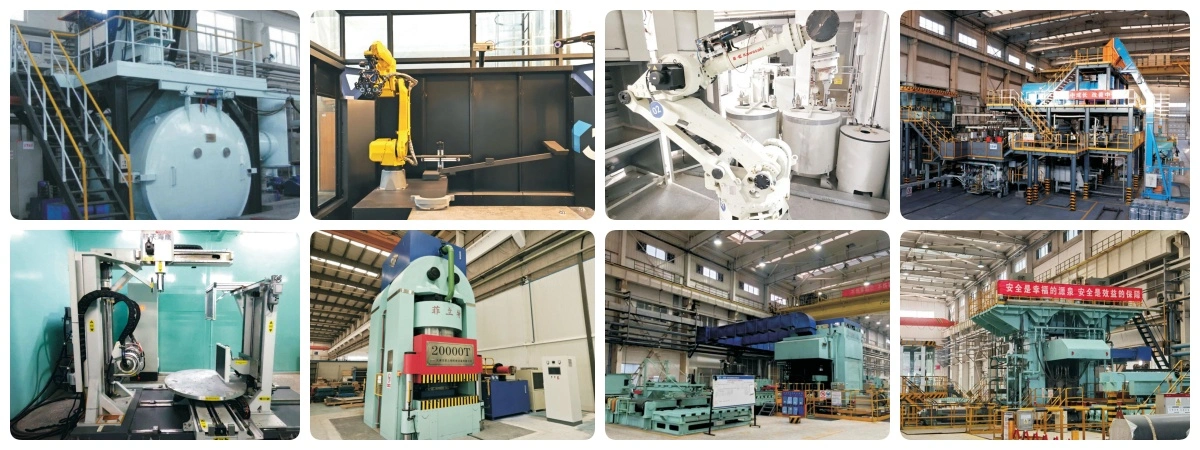
Our firm has 1500kg vacuum casting furnaces,EB smelting furnaces,vacuum heat treatment equipment and professional ultrasonic testing instruments . Its completely automated robotic shell-making production line enables multi-robot collaborative operation and full-process quality monitoring, assuring the batch quality and high completed product rate.
We have achieved CT8 high dimensional accuracy for satellite grade titanium castings, surpassing the industry standard CT9 design standards with a standard surface roughness of Ra 6.3μm. This high precision production capabilities guaranties exceptional forming quality and assembly accuracy of our Propeller Castings.
Quality Control and Inspection Protocols
All the titanium castings undergo rigorous and extensive quality inspection methods before delivery, to assure zero defect products for industrial applications.
Non-Destructive Testing (NDT) Ultrasonic Testing (UT) detects interior porosity and structural gaps ensuring overall internal and external structural integrity with no damage to finished components Dye Penetrant Inspection (DPI) checks for minute surface cracks and flaws.
Dimensional Metrology: Hydrodynamic blade profiles, pitch accuracy and overall dimensions are verified using 3D laser scanning and CMM coordinate measuring equipment to ensure full conformity to CAD design parameters.
Chemical Composition Analysis: Optical emission spectroscopy (OES) can accurately identify alloy composition, to ensure that all batches of goods match the specified grade requirements.
& Static Balancing Test Expert balancing calibration eliminates shaft misalignment and excessive bearing wear due to imbalanced blades, assuring smooth high-RPM performance.
We offer full product traceability across the whole process and compliance documentation that meets the certification standards of the leading classification organizations, including ABS, TUV and NORSOK.

Application Environments
Our cast titanium propeller components give steady and dependable performance in a variety of high-corrosion, high-precision industrial environments:
Marine Engineering : Titanium propellers have good saltwater corrosion resistance and anti biofouling qualities, and are extensively employed in ocean-going vessels, offshore platforms and naval equipment. Titanium is lighter than standard nickel-aluminum bronze materials and has a longer service life in hostile maritime settings.
Aerospace and Defense Aerospace propulsion and fluid transfer components must be lightweight and very structurally. High strength Gr5 (Ti-6Al-4V) titanium castings are now the norm for such precise equipment.
Chemical Processing: Titanium impellers and stirring castings for corrosive reaction kettles and abrasive slurry pump service conditions. Gr7 and Gr12 grades demonstrate high resistance to reducing acids and chloride containing chemical media.
Energy and Industrial Fluid Systems Power generating and petrochemical fluid equipment such as pump housings and valve bodies confront coupled pressure, temperature and chemical corrosion issues, in which titanium castings can provide long-term stable structural performance.

Customization and Supply Advantages
We provide full-process OEM services. Support individualized solutions from titanium grade selection, structural geometry design to precision machining and surface treatment. With steady semi-finished product inventories and established worldwide logistics cooperation channels, we can provide consistent and efficient delivery even for big batch orders.
Our whole industrial chain is performed in-house, from processing the titanium sponge to producing the final component, so that no outsourcing steps are needed in between. This ensures that the quality of the products is constant and can be controlled at every stage of production.
FAQ
Q1: Which titanium grade is suitable for marine seawater propeller components?
A: Gr2 pure titanium is ideal for conventional marine scenarios with corrosion resistance. Gr5 is preferred for projects requiring higher structural strength, while Gr7 and Gr12 are applicable for extremely corrosive chemical marine environments.
Q2: What is the maximum size and weight of your titanium propeller casting?
A: Our maximum casting dimension reaches 2500 × 2000 × 1000mm, with a maximum single-piece casting weight of 1500kg, covering large marine and industrial propeller customization demands.
Q3: How do you detect internal defects in titanium castings?
A: We adopt professional Ultrasonic Testing (UT) and Radiographic Testing (RT) to inspect internal structures, effectively detecting porosity, inclusions and hidden defects to meet industrial quality standards.
Q4: Is post-casting CNC machining available?
A: Yes. All cast blanks can be processed by precision CNC machining to achieve accurate dimensional tolerances, standard thread structures and customized surface finish requirements.
Q5: What industry standards and certifications do your products comply with?
A: Our products comply with AMS4985C, ASTM B367, GJB 2896A-2007 and other mainstream specifications. We hold AS9100, NADCAP, ABS, TUV, PED and NORSOK certifications to support global customer audit and compliance needs.
Q6: How to ensure high-precision blade pitch accuracy?
A: We use 3D laser scanning and CMM multi-point calibration to compare finished products with original CAD models, ensuring accurate blade profile and pitch parameters for stable hydrodynamic performance.
Contact Us
If you have procurement, technical consultation and customized development needs for high-performance Propeller Castings, please feel free to contact our professional technical team via srt@sunrui-ti.com.
