Investment Casting Of Titanium Alloys
Grade: Gr2, Gr3, Gr5, Gr1, Gr12, Gr7, Gr9, Gr23
Min. casting wall thickness: 0.4mm
Max. casting size: φ 1500mm × 600mm
Casting weight: 0.1~100kg
Surface roughness: Ra3.2~6.3μm
Executive standards: BMS 7-310, BMS 7-336, ASTM B367, GBIT 15073, GB/T 6614, GJB 2896A-2007, YY0117.3-2005, YY0117.1-2005
Investment Casting of Titanium Alloys — Precision Components for Aerospace, Medical & Marine Applications
Investment Casting of Titanium Alloys is a professional, high-precision manufacturing method used to make complex near-net-shape titanium parts that are stable in their dimensions and have good structural stability. Sunrui Titanium has been developing and improving titanium precision casting technologies on its own since 1994. This is built on more than 60 years of professional titanium R&D and production experience from CSSC. We consistently make 3 million precision castings each year, which puts us in the top three suppliers of cast titanium alloy golf club head blanks in the world. Our production range includes a wall thickness of at least 0.4 mm, a maximum workpiece size of 1500 mm × 600 mm, and a single-piece casting weight of between 0.1 kg and 100 kg. We provide, customized solutions for industrial clients around the world.
What Makes Titanium Investment Casting So Technically Demanding?
Titanium metal has a very high chemical activity when it is liquid at high temperatures. In normal casting conditions, it reacts quickly with oxygen, nitrogen, and carbon, which will seriously hurt the performance and stability of the parts. This means that regular atmospheric casting can't be used to make titanium at all.
They use advanced vacuum induction melting (VIM) technology along with professional yttria and zirconia neutral ceramic shell systems to get around this industry's technical bottleneck. This specific process stops the formation of brittle oxygen-rich alpha-case layers, which are the main reason why titanium parts wear out faster.
We cut down on the high costs of machining that come with traditional titanium billet processing by using a standardized and manageable Investment Casting of Titanium Alloys workflow. At the same time, the process allows combining several spread subassemblies into a single, solid piece. This makes the structure lighter while still maintaining its general strength.
Investment Casting Of Titanium Alloys Specifications
| Parameter | Details |
|---|---|
| Available Grades | Gr1, Gr2, Gr3, Gr5, Gr7, Gr9, Gr12, Gr23 |
| Min. Casting Wall Thickness | 0.4 mm |
| Max. Casting Size | φ1500 mm × 600 mm |
| Casting Weight Range | 0.1 – 100 kg |
| Surface Roughness | Ra 3.2 – 6.3 μm |
| Executive Standards | BMS 7-310, BMS 7-336, ASTM B367, GB/T 15073, GB/T 6614, GJB 2896A-2007, YY0117.3-2005, YY0117.1-2005 |
Core Material Advantages
Components made through Investment Casting of Titanium Alloys have many performance benefits over regular metals and are perfectly suited to high-standard industrial application scenarios.
Strength and Low Density: Titanium alloy has a density of 4.43 g/cm³, which is much lower than aluminum alloy and stainless steel. For aerospace structures and medical implant parts where every gram of weight matters, it achieves precise lightweight optimization.
Superb Corrosion Resistance: A stable and self-healing oxide film forms on the titanium surface, protecting it for a long time in chloride-filled environments, seawater, and body fluids. Many times better than regular stainless steel at resisting rust.
Wide Temperature Adaptability: Titanium castings provide complete structural stability in cryogenic (very cold) environments as well as high-temperature working conditions up to 500°C. This makes them very useful in harsh industrial settings.
Resistance to Fatigue and Creep: Titanium parts stay the same size and shape even when they are under constant stress and cycle load in aircraft and naval equipment for a long time, which dramatically increases their total service life.
Where These Castings Are Used
Aerospace & Defense
In many aircraft engines, our titanium castings are used to make compressor blades, fuselage structural brackets, and engine nacelle parts. An airplane's energy economy is improved by its light weight, and single forging or traditional machining methods can't make the complicated combined shapes that are possible with precision casting.
Implantable medical devices
Many medical devices, like femoral stems, acetabular cups, and spinal fusion cages, are made from titanium because it is exceptionally biocompatible. Casting creates a slightly net-shaped, open structure that works well to help osseointegration. As required by the industry, all of our medical castings strictly follow YY0117.1 and YY0117.3 standards.
Marine Processing and Chemical Production
Long-term exposure in ocean and acidic, toxic media don't affect the precision made impellers, valve bodies, and heat exchanger frames. In tough working conditions, titanium's better resistance to rust keeps stainless steel parts from breaking down too soon.
Activities and fun
Our main mass-production product is titanium metal golf club head blocks. Supported by large-scale automated precision casting production lines, we provide global sports equipment manufacturers with consistently finished goods.

Quality Control: What You Should Expect
Standardized inspection procedures and full quality documents are necessary for B-end buyers who want to buy high-performance titanium castings. Sunrui Titanium uses closed-loop quality tracking for the whole process for all finished parts:
Professional metallographic inspection confirms that the chemical milling process completely removed the brittle surface oxide layers. This ensures that the structural components will continue to work well even after they've been used for a long time.
For non-destructive testing (NDT), X-ray radiographic testing according to ASTM E1742 finds internal shrinkage cavities and inclusions, and fluorescent penetrant inspection (FPI, ASTM E1417) finds all the small cracks and structural flaws on the surface.
Hot Isostatic Pressing (HIP): This high-temperature and high-pressure treatment after casting gets rid of any tiny holes inside the metal. This makes the castings' mechanical properties similar to those of forged parts, and full records of the microstructure and density can be kept.
Chemical Composition Analysis: OES and ICP testing carefully monitors the amount of interstitial elements like oxygen, nitrogen, hydrogen, and carbon, making sure they stay within normal limits so that materials don't become weak or lose their performance.
As9100, NADCAP, PED, ABS, TUV, and NORSOK are just a few of the important worldwide certifications we hold. For every batch of orders, we provide full product tracking and approved quality papers.

Manufacturing Capability and Customization
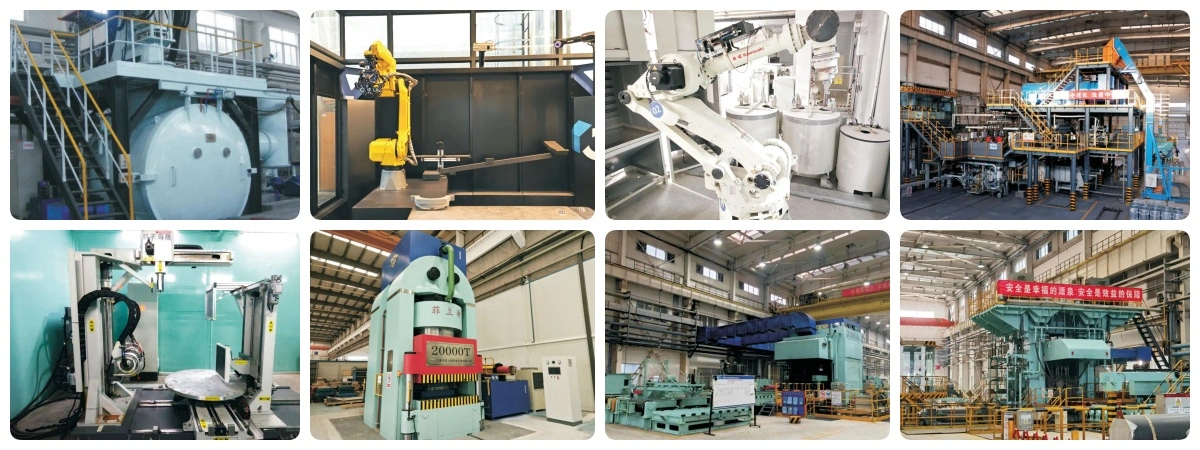
We are equipped with fully automated robot shell-making production lines for titanium casting. Multi-robot collaborative operation and full-process intelligent quality monitoring greatly improve production consistency, product yield and on-time delivery rate.
We support full-grade customization, covering commercial pure titanium Gr1/Gr2, high-strength structural titanium Gr5, and medical-grade Gr23 (Ti-6Al-4V ELI). All-round OEM customized services are available, including dimensional tolerance adjustment, alloy grade selection and personalized post-processing treatments.
The standard as-cast surface roughness reaches Ra 3.2–6.3 μm. We can further surface finish through chemical polishing, sandblasting and other processes according to customer application requirements.
FAQ
Q1: Why is titanium alloy investment casting more costly than steel casting?
A: The higher cost mainly stems from vacuum melting equipment investment and high-cost yttria/zirconia non-reactive ceramic shell materials. These professional configurations are necessary to counteract titanium’s high-temperature chemical activity and guarantee casting purity.
Q2: What dimensional tolerances can your titanium castings achieve?
A: Our standard casting tolerance ranges from ±0.1 mm to ±0.5 mm, varying with part size and structural complexity. Precision secondary machining is available for key matching surfaces to meet tighter tolerance requirements.
Q3: What improvements does HIP treatment bring to castings?
A: HIP process eliminates internal micro-pores and voids through simultaneous high temperature and high pressure, improving casting density and overall mechanical properties, making the performance index close to wrought and forged titanium parts.
Q4: Is alpha-case removal mandatory for all titanium castings?
A: It is a mandatory process for aerospace and fatigue-critical components. Unremoved alpha-case will seriously reduce part fatigue life and cause premature cracking failure.
Q5: Which titanium grade is preferred for aerospace structural castings?
A: Gr5 (Ti-6Al-4V) is the most widely used aerospace grade. After professional HIP treatment, its tensile strength reaches 895–1000 MPa with 6–10% elongation, meeting most high-strength structural application requirements.
Q6: Do you support prototype and small-batch customized orders?
A: Yes. We provide one-stop services from prototype trial production, small-batch verification to large-scale mass production, supporting full-custom OEM solutions for all titanium grades and casting specifications.
Contact Us
If you have technical consultation, sample customization and batch procurement needs for Investment Casting of Titanium Alloys precision components, feel free to contact our professional technical team via srt@sunrui-ti.com.
