Prosthetic Limb Components
Grade: Gr2, Gr3, Gr5, Gr12
Min. casting wall thickness: 0.4mm
Max. casting size: φ 1500mm × 600mm
Casting weight: 0.1~100kg
Surface roughness: Ra3.2~6.3μm
Executive standards: BMS 7-310, BMS 7-336, ASTM B367, GBIT 15073, GB/T 6614, GJB 2896A-2007, YY0117.3-2005, YY0117.1-2005
Prosthetic Limb Components — Precision Casting Solutions for Medical-Grade Performance
For clinical and daily rehabilitation use, Prosthetic Limb Components must meet extremely high standards for material stability, precision in measurements, and long-term biocompatibility. The CSSC Luoyang Ship Material Research Institute has given Sunrui Titanium more than 60 years of professional experience in titanium research and production. They use this experience to make custom castings for medical prosthetics. We can make things with a minimum wall thickness of 0.4mm, a maximum workpiece size of 1500mm × 600mm, and a weight range of 0.1 kg to 100 kg per piece. All of the parts are carefully designed to work with current prosthesis structures and the long-term recovery needs of patients.
What Makes Titanium the Ideal Material for Prosthetic Components?
Titanium has been known for a long time to be the best material for medical and prosthetic structural parts that need to hold weight. Its great strength-to-weight ratio makes prosthesis equipment lighter, which makes daily movement easier and less tiring for the user while still keeping great structural load-bearing capacity.
Titanium also has good osseointegration ability, which means it can join securely with real bone cells to make bone-integrated prosthesis systems. For high K3–K4
Titanium and oxygen, nitrogen, and carbon are easy for titanium molten liquid to react with at high temperatures. To keep the material pure and prevent performance from dropping, Sunrui Titanium uses full vacuum casting environments for all of its production. This makes sure that every batch of Prosthetic Limb Components has the same quality and properties.
Technical Specifications
| Parameter | Details |
|---|---|
| Grade | Gr1, Gr2, Gr3, Gr23 |
| Min. Casting Wall Thickness | 0.4mm |
| Max. Casting Size | φ1500mm × 600mm |
| Casting Weight Range | 0.1 – 100kg |
| Surface Roughness | Ra3.2 – 6.3μm |
| Executive Standards | BMS 7-310, BMS 7-336, ASTM B367, GB/T 15073, GB/T 6614, GJB 2896A-2007, YY0117.3-2005, YY0117.1-2005 |
Key Performance Advantages
Prosthetic Limb Components possess irreplaceable performance advantages compared with traditional metal materials, fully meeting the strict service requirements of medical prosthetic devices:
Specific Strength: Titanium’s strength-to-weight ratio outperforms most engineering metals. It realizes lightweight optimization of prosthetic parts without reducing structural load capacity, meeting the use standards of K3–K4 high-activity users and high-weight users.
Corrosion Resistance: Ordinary metal prosthetic parts are prone to oxidation and structural jamming in clinical environments and humid aquatic scenarios. The natural self-protective oxide film on titanium surface resists erosion of body fluids, salt spray and humid air, ensuring long-term stable operation of prosthetic equipment in various complex environments.
Fatigue and Creep Resistance: Medical prosthetic parts need to withstand up to 3 million cyclic load tests in accordance with ISO 10328 standards. Our vacuum-cast titanium components pass standard fatigue tests with stable performance, ensuring no structural failure during the whole service life of prosthetics.
Temperature Performance: Titanium maintains stable mechanical properties in variable temperature environments. It can adapt to outdoor temperature changes and the working temperature of supporting electronic components such as microprocessor knees, avoiding performance fluctuations caused by temperature difference.
Manufacturing Capability and Quality Control
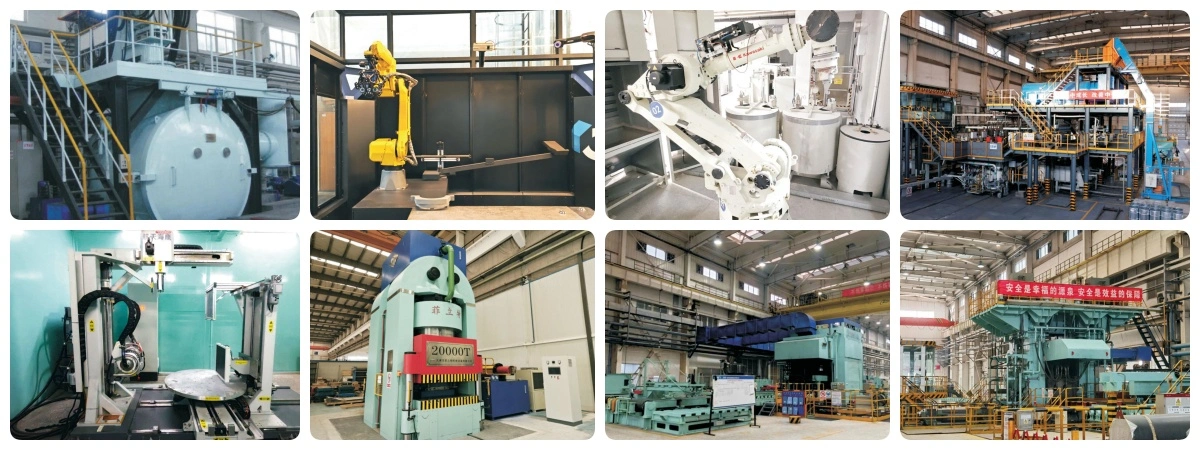
We are equipped with fully automatic robot shell-making production lines for titanium investment casting. Multi-robot collaborative operation and full-process real-time quality monitoring effectively eliminate batch quality differences and improve finished product yield and dimensional consistency.
Our precision casting technology has reached CT8 high dimensional accuracy, exceeding the traditional CT9 design standard, with controllable surface roughness up to Ra6.3μm. We apply the same high-standard manufacturing and inspection system to all medical-grade titanium prosthetic parts.
Full-range quality tests are implemented for finished products, including static load test, torsion resistance test, salt spray corrosion test and high-precision dimensional tolerance calibration. The male and female pyramid adapter interfaces of prosthetic parts are precisely machined to eliminate assembly gaps and walking noise, ensuring smooth and stable user movement.
We hold authoritative international certifications such as AS9100, NADCAP, PED, ABS, TUV and NORSOK, providing complete product traceability and compliance documents for global medical device procurement customers.

Prosthetic Limb Components Application Scenarios
Our custom titanium casting parts are widely applicable to various mainstream prosthetic assembly systems, covering multiple clinical and daily usage scenarios:
High-Activity Transtibial Systems: For K4-level high-activity users and athletes, titanium pylons and structural adapters provide sufficient structural rigidity and ultra-long fatigue life, adapting to high-strength movement scenarios such as running and hiking.
Transfemoral and Knee Systems: Precision cast titanium adapters are perfectly matched with multi-center knee joints and vacuum suspension systems. They realize stable load transmission, reduce the fall risk of elderly and moderate-activity users, and improve wearing safety.
Implant-Integrated Prosthetics: Gr23 medical-grade titanium castings support bone integration limb replacement systems. Stable bone interface bonding effectively improves patients' mobility and long-term rehabilitation quality.
We provide professional OEM customized services for prosthetic equipment manufacturers, supporting flexible batch production and personalized structural casting according to customer design drawings and clinical application requirements.

FAQ
Q1: Which titanium grades are suitable for prosthetic structural adapters?
A: Gr23 (Ti-6Al-4V ELI) is the preferred grade for high-load and body-contact prosthetic components due to its premium biocompatibility and fatigue resistance. Gr2 is ideal for low-load and non-implant prosthetic auxiliary parts.
Q2: What is the minimum wall thickness of your titanium prosthetic castings?
A: We stably achieve a minimum casting wall thickness of 0.4mm, enabling lightweight thin-walled structural design to reduce overall prosthetic weight while guaranteeing structural strength and safety.
Q3: How do you guarantee batch dimensional consistency?
A: Relying on fully automated robot shell-making lines and full-process quality monitoring, all castings are inspected according to CT8 precision standards, with surface roughness stably controlled at Ra3.2–6.3μm to ensure zero batch difference.
Q4: Do you support customized OEM prosthetic components?
A: Yes. We provide one-stop OEM customization services, including personalized geometry, grade selection and surface finish treatment, fully matching your prosthetic product design and clinical application needs.
Q5: What industry standards do your products comply with?
A: Our titanium prosthetic castings strictly comply with ASTM B367, GB/T 15073, GJB 2896A-2007 and medical YY0117.1/YY0117.3 standards, meeting global medical device procurement qualification requirements.
Q6: What surface finish can be customized for prosthetic parts?
A: The standard as-cast surface roughness is Ra3.2–6.3μm. We can provide finer polishing and finishing treatments according to your interface assembly and biocompatibility requirements.
Contact Us
If you are looking for high-precision, medical-grade Prosthetic Limb Components for product development and batch procurement, feel free to contact our professional technical team via srt@sunrui-ti.com.
