Titanium Lost-Wax Castings
Grades: Gr2, Gr3, Gr5, Gr1, Gr12, Gr7, Gr9, Gr23
Minimum casting wall thickness: 0.4mm
Maximum casting size: φ 1500mm × 600mm
Casting weight: 0.1~100kg
Surface finish: Ra3.2~6.3μm
Standards: BMS 7-310, BMS 7-336, ASTM B367, GBIT 15073, GB/T 6614, GJB 2896A-2007, YY0117.3-2005, YY0117.1-2005
Titanium Lost-Wax Castings for Aerospace, Medical & Marine — Precision Near-Net Shape Solutions
Titanium Lost-Wax Castings by Sunrui Titanium deliver high-integrity, complex-shaped titanium components with stable precision and performance. Our production range covers a minimum wall thickness of 0.4 mm, single-piece weight of 0.1–100 kg, and maximum casting dimension of φ1500 mm × 600 mm. Backed by 60+ years of professional titanium industry technology inherited from CSSC Luoyang Ship Material Research Institute, we hold full authoritative certifications including AS9100, NADCAP, PED, ABS, TUV and NORSOK. With an annual output of 3 million precision castings and full coverage of mainstream titanium grades from Gr1 to Gr23, we fully meet high-standard B2B procurement demands for aerospace, marine engineering, medical devices and petrochemical industries.
What Are Titanium Lost-Wax Castings?
Commonly referred to as titanium investment casting, Titanium Lost-Wax Castings adopt mature sacrificial wax pattern technology. We build professional ceramic shell molds based on custom wax models to produce near-net-shape titanium parts with structures that traditional processing cannot achieve. The entire production process adopts vacuum melting and centrifugal casting technology, which is essential for titanium production. Titanium exhibits extremely high chemical activity at high temperatures and will react rapidly with oxygen, nitrogen and carbon in the air, leading to material contamination and performance failure.
Compared with traditional solid billet CNC machining, this lost-wax casting process greatly reduces raw material waste and subsequent processing workload. For high-value titanium alloys represented by Gr5 (Ti-6Al-4V), it effectively lowers the buy-to-fly ratio and cuts overall production costs for mass orders. The process supports one-time forming of complex structures such as internal flow channels and ultra-thin walls, breaking through the structural limitations of forging processing.
Key Material Properties and Technical Advantages
Titanium alloy castings feature a combination of mechanical and chemical properties, delivering irreplaceable application value in various harsh high-performance working environments:
High Specific Strength: Lightweight yet high-strength, its structural strength exceeds most steel materials, realizing effective equipment weight reduction without sacrificing load-bearing capacity.
Corrosion Resistance: The self-healing TiO₂ oxide protective film on the titanium surface stably resists erosion of chloride media, acidic solutions and salt spray, adapting to long-term corrosive working conditions.
Wide Temperature Adaptability: Components maintain complete structural stability and mechanical properties in both cryogenic low-temperature and high-temperature service environments, with strong environmental tolerance.
Fatigue & Creep Resistance: It can withstand long-term cyclic loading and sustained stress, making it ideal for rotating parts and structural components with high service life requirements.
Among all grades, Gr5 (Ti-6Al-4V) is the most widely used. It has a density of 4.43 g/cm³ and stable tensile strength of 895–1000 MPa. The standard as-cast surface roughness is controlled at Ra 3.2–6.3 μm, which can be directly used or matched with simple finishing treatment.
Product Specifications
| Parameter | Details |
|---|---|
| Available Grades | Gr1, Gr2, Gr3, Gr5, Gr7, Gr9, Gr12, Gr23 |
| Min. Casting Wall Thickness | 0.4 mm |
| Max. Casting Size | φ 1,500 mm × 600 mm |
| Casting Weight Range | 0.1 – 100 kg |
| Surface Roughness | Ra 3.2 – 6.3 μm |
| Executive Standards | BMS 7-310, BMS 7-336, ASTM B367, GB/T 15073, GB/T 6614, GJB 2896A-2007, YY0117.3-2005, YY0117.1-2005 |
Quality Control: What Sets Sunrui Apart
High-precision titanium casting production relies on strict full-process process control. The biggest challenge in production is the generation of Alpha Case, a brittle oxygen-rich surface layer formed during high-temperature casting. Unremoved Alpha Case will easily cause structural fatigue failure and affect the service safety of components.
We have formulated a complete set of standardized quality inspection protocols to ensure 100% qualified finished parts:
Fluorescent Penetrant Inspection (FPI): Implemented in accordance with ASTM E1417 to fully screen surface micro-cracks and cold shut defects, ensuring complete surface structural integrity.
Radiographic X-Ray Inspection: Conducted per ASTM E1742 to detect internal shrinkage cavities, pores and inclusions, eliminating hidden internal quality hazards.
Precision Chemical Analysis: Adopting spark atomic emission spectroscopy to strictly control the content of interstitial elements such as oxygen, nitrogen, hydrogen and carbon within standard limits to avoid material embrittlement.
Alpha Case Removal Verification: Mandatory process for aerospace-grade products. We verify the complete removal of brittle layers through metallographic detection and precise chemical milling depth control.
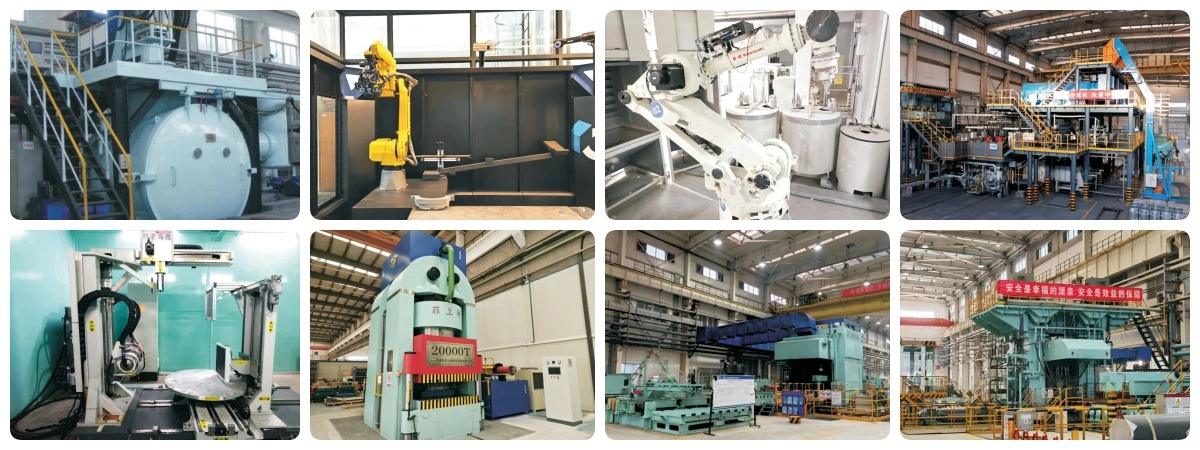
HIP Post-Processing: Hot isostatic pressing is provided for high-demand parts to eliminate internal micro-voids, greatly improving fatigue resistance and making mechanical properties close to forged titanium parts. Our fully automated robot shell-making production line ensures stable quality and consistent batch performance for high-volume production of Titanium Lost-Wax Castings.

Applications Across High-Performance Industries
Our titanium precision castings are for high-standard industrial scenarios that pursue zero failure rate:
Aerospace Industry: Widely used in aero-engine compressor blades, structural brackets and bleed air valves. The parts stably resist extreme centrifugal force and cyclic thermal stress. Near-net-shape casting greatly reduces the machining cost of high-value alloys, and our products have reached CT8 high dimensional accuracy for satellite applications, exceeding the traditional CT9 design standard.
Medical & Orthopedic Industry: Applicable to femoral stems, acetabular cups, dental implants and other implant parts. The casting process forms a porous surface structure to promote osseointegration. All products comply with YY0117.1-2005 and YY0117.3-2005 medical standards. We have realized large-scale mass production of titanium and CoCrMo medical castings.
Marine & Chemical Processing: Custom cast pump impellers, seawater valves and heat exchanger manifolds adapt to harsh environments such as deep-sea seawater and nitric acid corrosion. Gr2 and Gr7 titanium grades deliver long-term corrosion resistance for these scenarios.
Sports & Leisure Industry: We rank among the world’s top three manufacturers of cast titanium alloy golf club head blanks. With stable control of wall thickness, surface finish and weight accuracy, we support long-term high-volume stable supply for sports equipment brands.

FAQ
Q1: Why are titanium lost-wax casting more costly than stainless steel castings?
A: Titanium casting requires professional vacuum melting equipment and high-purity yttria/zirconia non-reactive ceramic molds to avoid material contamination. Although the process cost is higher, the integrated forming feature reduces subsequent machining procedures and procurement costs for customers.
Q2: What is the tooling and sample lead time for new projects?
A: The conventional cycle for wax mold development and first article inspection (FAI) report delivery is 6–10 weeks. The cycle will be slightly adjusted according to part structural complexity and tolerance requirements.
Q3: Can the Alpha Case layer be completely removed?
A: Yes. We adopt professional chemical pickling and precision processing technology to completely remove the brittle Alpha Case layer. This is a mandatory standard process for all aerospace and medical-grade titanium castings.
Q4: What performance improvements can HIP treatment bring?
A: HIP technology eliminates internal micro-voids of castings through high temperature and high pressure, effectively improving part density and fatigue life, making the mechanical performance of castings comparable to forged titanium materials.
Q5: What are the most commonly used titanium grades for casting?
A: Gr5 (Ti-6Al-4V) is the mainstream grade for aerospace and structural parts relying on its high specific strength. Gr2 is widely used for marine and chemical equipment requiring corrosion resistance.
Q6: What industry standards do your products comply with?
A: Our castings fully comply with ASTM B367, BMS 7-310, GJB 2896A-2007, YY0117.1/YY0117.3 and other domestic and international standards, supported by authoritative AS9100 and NADCAP system certifications.
Contact Us
If you have technical consultation, sample customization and batch procurement needs for Titanium Lost-Wax Castings, please get in touch with our professional team viasrt@sunrui-ti.com.
